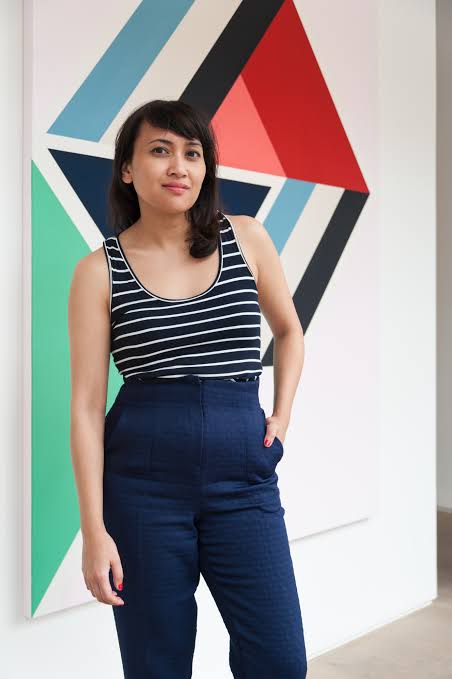
Known for her fascination with colour and composition, Sinta Tantra’s work is an experiment in scale and dimension, a hybridity of pop and formalism, an exploration of identity and aesthetics. Her decade of work in the public realm produced distinct colour abstractions which wrapped around the built environment, enlivening and transforming them in the process. Her work now ranges from small painted canvases to huge architectural installations, from bold, tropical colour to a calder-like minimalism. It occupies a space at the intersection between painting and architecture, striking a fine balance between the two-dimensional and three-dimensional, decorative and functional, public and private.
What are the usual themes in your work?
I would describe myself as a painter who works on an architectural scale: I'm interested in colour, shape and form; the fine line that separates the two and three dimensions; the idea of turning the 'white cube' space inside out. This is also true of the scale I work on, which can run from an intimate painting inside the gallery space to a 300-metre long bridge in the city. What's common to all of this is my overarching ambition to use architectural spaces to inject colour and light, altering the way we see.
Tell us about your latest project/s or anything you are currently working on.
I've just come back from the Karachi Biennial in Pakistan, and I'm just about to fly to Sharjah in the UAE, to install a 50m long floor painting as part of the Islamic Arts Festival which opens on the 11th December. The last year has been more or less constant travelling, but I love it - it's been very inspiring.
How do you study or research for a project?
It's an ongoing process: places, books, conversations, and such lodge in my mind, and at some point align with the colours, shapes, and images I'm developing in the studio. I'll often make lots of sculptural maquettes to visualise not only the location of the artwork, but more importantly - how we physically approach the space.
What are the processes involved in your art-making?
My process is more akin to a designer or an architect than a traditional painter. I create drawings on the computer first, which then become blueprints. These blueprints then get transferred onto the surface or site I am painting. Paint is applied colour by colour, masking each layer carefully. I paint on linen canvases and mix all the tempera paint myself so that it matches the exact colour effect I want to achieve.
Name some of the artists who have influenced you in your practice.
From Bali, it would be I Nyoman Lempad (1862–1978) - a Balinese stone sculptor and architect from the early twentieth century. His drawings are exquisite. From Europe, the Bauhaus School (1919 - 1933) has been an enduring influence. I'm drawn to their attempt to continuously challenge the hierarchies of 'fine art', while also blurring the boundaries between art and the everyday.
AVAILABLE ARTWORK
[get_creation]
SIMILAR NEWs & BLOGS
Artist Focus: Peter Zimmermann
Peter Zimmermann’s solo exhibition with Modeka Art is an expression of his artistic process with epoxy – showing artworks that are rich with colors thus making his work extremely diverse.

Artist Focus: Anna Bautista
Anna Bautista is a young artist based in Manila, whose works mostly tackle on the takeover of consumerism and Pop Culture in modern day society.